
You Found a Beachfront Apartment in Limassol, a Villa in Paphos, or a New-Build Qualifying for the Golden Visa. Nobody Has Mentioned That Half the Foreign-Owned Properties in That City Lack Title Deeds, That the Developer's Lawyer Works for the Developer, or That a 5-Square-Metre Miscalculation on Buildable Area Can Cost You an Extra 56,000 Euros in VAT.
You have scrolled through Bazaraki listings, compared Rightmove Cyprus prices, and read developer brochures advertising 340 days of sunshine and seamless EU residency. You have browsed r/cyprus and r/EuropeFIRE where expats post contradictory advice about title deeds, Non-Dom status, and whether the 60-day tax rule still requires you to prove you are not tax resident elsewhere. You have seen estate agents quote transfer fees without mentioning that stamp duty was abolished on January 1, 2026 -- a detail half the English-language blogs still get wrong.
You are not confused because you have not researched enough. You are confused because Cyprus layers a notorious title deed crisis on top of a residency program that quietly raised its income threshold to 50,000 euros in 2023, a tax reform package that took effect on January 1, 2026, a divided island where buying in the wrong half exposes your worldwide assets to EU-enforceable restitution claims, and a construction industry that builds houses prone to severe dampness and black mold every winter -- all wrapped in English common law familiar enough to feel safe, but with local administrative quirks that catch every foreign buyer who skips independent legal counsel.
Here is the problem no free resource solves: Cyprus runs on a system where a developer can sell you a fully paid property on land still encumbered by their commercial mortgage, where the lawyer they recommend has a financial incentive to skip the Land Registry search that would expose it, where Council of Ministers approval is required for non-EU buyers but nobody explains Form Comm. 145 or the 4,014 square metre cap, where the 5% reduced VAT rate has a 190 square metre cliff that voids the entire discount if you exceed it by a single square metre, and where an apartment in Northern Cyprus priced in Turkish Lira can trigger an EU-wide restitution claim under the Orams v Apostolides precedent that follows your assets home. The legal protections exist. But they only work if you know they exist, understand the sequence, and trigger them in the right order.
The Buying Property in Cyprus -- Expat Guide is the Expat Protection Blueprint. Not a developer blog designed to funnel you toward a listing. Not a law firm marketing page designed to sell retainers. It is a structured decision system that decodes every stage of the Cypriot property purchase -- from verifying title deed status at the District Lands Office, through the trapped buyer crisis, the developer's lawyer conflict of interest, Council of Ministers approval, the 2026 tax reform, and Permanent Residency by Investment -- so you make each decision understanding the legal mechanism behind it, the government office responsible for it, and the financial consequence of skipping it.
What's Inside the Expat Protection Blueprint
The complete guide (66 pages) plus six standalone printable tools -- covering every stage from property search through title deed transfer, with the structural detail that developer blogs and commission-driven agents leave out:
Foreign Ownership Rights -- The Hard Legal Line Between EU and Non-EU Buyers
Cyprus draws a strict distinction between EU/EEA/Swiss citizens (unrestricted acquisition rights) and non-EU nationals (limited to one residential property). The 2025-2026 legislative change that redefined any Cypriot company whose ultimate beneficial owner is non-Cypriot as a "foreign entity" -- closing the corporate multi-property loophole. Post-Brexit classification of British buyers as third-country nationals subject to the one-property restriction, the 200 square metre threshold for avoiding Council of Ministers approval, and the 90/180-day stay limit that means buying a house alone does not grant residency. When you need Form Comm. 145, what it requires, and the 4,014 sqm land cap that limits estate-building in your personal name.
The Title Deed Crisis -- How Buyers Got Trapped and How to Avoid It
The decades-long scandal where developers secured massive commercial mortgages on entire developments, sold individual units, pocketed the money, and left buyers unable to obtain title deeds because the land remained encumbered. In Limassol alone, out of 2,561 properties purchased by Russian nationals, only 1,292 have actual title deeds -- roughly half are in some degree of legal limbo. Law 110(I)/2025 and the 32-month forced resolution timeline. The bank consent process. The District Court remedy when banks unreasonably refuse. How to conduct a District Lands Office encumbrance search before paying any non-refundable deposit. How to secure a formal bank waiver that releases your specific unit from a developer's overarching mortgage -- the single document that would have prevented the entire crisis.
The Developer's Lawyer Trap -- The Conflict of Interest That Costs Buyers Their Title Deeds
Standard practice in Cyprus: estate agents and developers aggressively recommend their preferred lawyer, promising discounted fees and a streamlined process. The reality is a devastating conflict of interest. A lawyer receiving steady referral business from a developer has every incentive to skip the Land Registry mortgage search, overlook missing building permits, neglect to register your contract for Specific Performance, and gloss over the fact that the developer has a massive commercial charge on the land. The guide explains how to find genuinely independent counsel through the Cyprus Bar Association, the four questions that expose developer-aligned lawyers, and what your independent lawyer must verify at the District Lands Office before you sign anything.
Costs, Taxes, and the 2026 Reform -- Every Euro You Need to Budget
Transfer fees at the current 50% discount (effective rates of 1.5% to 4% depending on price bracket). Stamp duty abolition as of January 1, 2026. The 5% reduced VAT rate on new builds and the three thresholds that must all be met simultaneously: 130 square metre cap on the reduced rate, 190 square metre total buildable area limit, and the 475,000 euro value ceiling. What happens if you exceed any threshold by even one square metre -- the cliff that turned a minor architectural discrepancy into a 56,000 euro VAT surprise for buyers who did not read the fine print. The newly doubled Capital Gains Tax exemptions. Worked cost examples for a 250,000 euro resale apartment and a 400,000 euro new-build villa.
The Golden Visa -- Permanent Residency by Investment at 300,000 Euros
The minimum new-build investment from a licensed developer (resale does not qualify). The 2023 income reforms: 50,000 euros secured annual foreign income for the main applicant, plus 15,000 for a spouse and 10,000 per dependent child. The abolition of parent and parent-in-law inclusion. Mandatory annual compliance declarations. How Cyprus compares to Greece (800,000 euro threshold in major areas), Portugal (program closed), Malta (higher blended cost), and Spain (program restricted). Processing timeline through the Civil Registry and Migration Department. The visit requirement, the card renewal cycle, and the investment maintenance obligation.
The 60-Day Tax Rule and Non-Dom Status -- 0% Tax on Worldwide Dividends
How to become Cyprus tax resident by spending just 60 days on the island. The pivotal January 1, 2026 reform that removed the requirement to prove you are not tax resident elsewhere -- and why this matters for UK and US expats with existing ties. Non-Domiciled status and the 17-year exemption from Special Defence Contribution, meaning zero tax on worldwide dividend and interest income. The 2026 abolition of Deemed Dividend Distribution for corporate profits. Zero tax on securities capital gains. Zero inheritance tax. The abolition of SDC on rental income. The strategic calculus for remote workers, crypto investors, and tech founders.
Financing -- Mortgages for Foreigners
Which Cypriot banks lend to non-residents (Bank of Cyprus, Eurobank, AstroBank, Alpha Bank). LTV ratios of 60% to 70% for non-EU nationals. Current interest rates around 3.8% to 5.5%. AML documentation requirements and the source-of-wealth evidence Cypriot banks demand for international transfers above 5,000 euros. Developer payment plans as an alternative -- the typical 30/30/30/10 milestone structure, and the developer insolvency risk you accept by bypassing bank financing.
Location Guide -- Where to Buy
Limassol (Russian and tech corporate hub, luxury high-rises, 3,500 euros per square metre, 6% gross rental yield), Paphos (British retiree corridor, 4,483 UK-owned properties, 1,780 euros per square metre, English universally spoken), Larnaca (Lebanese and Israeli buyers, fastest residential growth in Cyprus, airport proximity, emerging tech corridor), Nicosia (domestic market, 98,205 Cypriot-owned vs 5,236 foreign), Ayia Napa and Paralimni (holiday rental epicenter, high summer yields, severe winter vacancy). What each micro-market actually suits versus what agents push you toward.
Property Quality and Winter Issues -- The Reality Behind 340 Days of Sunshine
Poor thermal insulation, missing damp-proof coursing, inadequate ventilation, and construction materials with high salt content causing efflorescence. Six specific inspection checks for cold spots, black mold, condensation damage, single-glazed windows, and absent central heating -- before paying a reservation fee. Realistic winter heating costs of 200-400 euros per month that blindside Northern European expats. Remediation costs: external wall insulation at 40-80 euros per square metre, double-glazing replacement at 300-600 euros per window, full damp-proofing treatment starting at 3,000-5,000 euros.
North Cyprus -- Why This Guide Says Stay Away
The critical difference between Republic of Cyprus title deeds and Northern Cyprus deeds. Three categories of Northern title: pre-1974 Turkish deeds (Turk Kochanli -- relatively safe but scarce), Exchange deeds (Esdeger -- legally disputed), and Allocation deeds (Tahsis -- highest risk). The Orams v Apostolides ruling: a British couple who purchased a villa in the North had a Republic of Cyprus court judgment enforced against them across the EU and UK. Greek Cypriot restitution claims on Northern properties are legally enforceable against your home-country assets. The low prices in Turkish Lira are not the bargain they appear to be.
The Complete Due Diligence Checklist
Every Land Registry check, planning and building compliance verification, financial and tax calculation, developer solvency search, and contract protection clause mapped as an actionable checklist. The six critical mistakes foreign buyers make in Cyprus -- and the specific chapter that explains how to avoid each one.
Plus Six Standalone Printable Tools
In addition to the full guide, you get standalone PDFs you can print and bring to property viewings, lawyer meetings, and financial planning sessions:
- Due Diligence Checklist -- All 14 verification items across five categories, formatted as a printable worksheet to bring to your lawyer's office
- Cost Calculator Worksheet -- Transfer fee tiers, VAT threshold reference, two worked examples, and a fillable section for calculating your own property's total acquisition cost
- Golden Visa Planner -- Permanent Residency requirements, income thresholds, application checklist, and EU Golden Visa comparison table at a glance
- Winter Inspection Checklist -- Six physical checks for dampness, mold, insulation, glazing, heating, and ventilation to perform at every property viewing, with remediation cost estimates
- Location Comparison Matrix -- Limassol, Larnaca, Paphos, Nicosia, and Ayia Napa compared on price, yield, demographics, and suitability
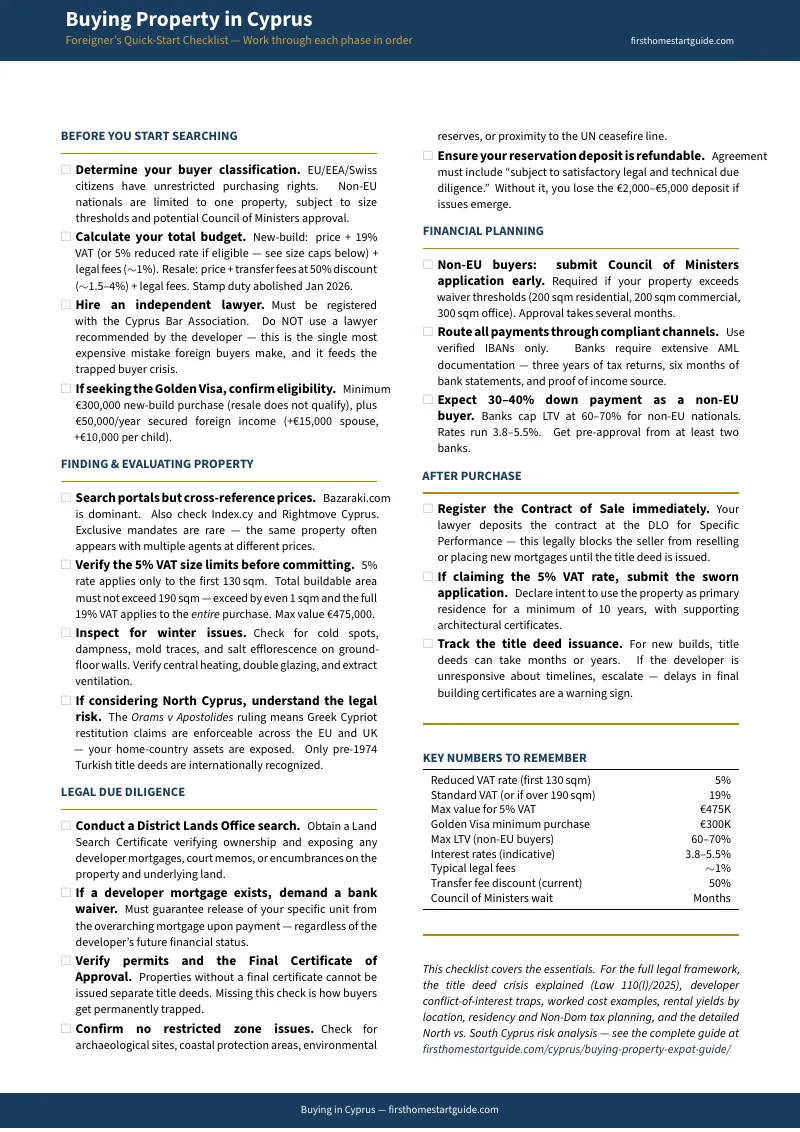
- Foreigner's Quick Checklist -- The 18-item action plan across five phases that you also receive as a free download
Who This Guide Is For
This guide is for foreign buyers and expats purchasing property in Cyprus who:
- Are buying their first Cypriot property and need the entire transaction mapped -- from hiring an independent lawyer through District Lands Office registration -- so they understand what happens at each stage, what it costs, and what can delay or trap the purchase
- Are British post-Brexit and need to understand that buying property alone does not grant residency, that the one-property restriction applies, and that the 90/180-day rule means year-round living requires a formal residency permit
- Are non-EU nationals (American, Canadian, Australian, Israeli, Lebanese, Russian) who need to understand the Council of Ministers approval process, the one-property limit, the corporate loophole closure, and how the 300,000 euro Permanent Residency program works under the 2023 income requirements
- Are tax-motivated buyers -- remote workers, digital nomads, tech founders, crypto investors -- evaluating Cyprus for the 60-day rule and Non-Dom status and need the exact mechanics of the 2026 reforms, not a developer's marketing summary
- Need to protect themselves from the trapped buyer crisis -- understanding how to check for developer mortgages at the District Lands Office, when to demand a bank waiver, and why using the developer's recommended lawyer is the single most expensive mistake in Cyprus real estate
- Are retirees considering Paphos or Larnaca who want honest information about winter living conditions, construction quality, realistic heating costs, and the 5% flat tax on foreign pension income -- not the sanitised version from a developer brochure
Why Not Free Resources?
Free information on buying property in Cyprus is abundant. Here is what each source actually delivers:
- Developer marketing materials advertise 340 days of sunshine, seamless EU residency, and the 5% reduced VAT rate. They do not mention the title deed crisis, the developer's lawyer conflict of interest, the VAT cliff at 190 square metres, or houses that grow black mold every winter. The information is curated to move you toward a purchase. The risks that could cost you the entire investment are omitted.
- Law firm conveyancing guides (George K. Konstantinou, AGP Law) provide detailed breakdowns of the 60-day rule, the Non-Dom regime, and the conveyancing steps. They are accurate. They are also top-of-funnel lead generators for legal services that cost 2,000-5,000 euros, and they tend to minimise complexity to encourage inquiries rather than scare you into caution.
- PwC, KPMG, and Savills macro reports deliver pristine data on construction indices, outstanding housing loan rates, and aggregate transaction volumes. They are written in financial jargon for institutional investors and policy makers. A first-time foreign buyer looking for a step-by-step guide to avoiding trapped title deeds will not find what they need in a 60-page institutional PDF.
- Reddit (r/cyprus, r/EuropeFIRE) contains genuine buyer experiences alongside Golden Visa advice that predates the 2023 income reforms, tax guidance that does not reflect the 2026 DDD abolition or the stamp duty repeal, and cautionary tales about the 2013 banking crisis that may or may not reflect current deposit protection. You will find someone who closed in six weeks and someone whose title deed never arrived. Both stories are true. Neither tells you which outcome applies to your situation.
- Government and Bar Association websites publish basic checklists and conveyancing outlines. They are poorly translated, difficult to navigate, and lack the contextual warnings about developer mortgages, conflict of interest, and construction quality that determine whether your purchase succeeds or traps you.
This guide fills the structural gap -- the space between knowing that title deed problems exist and understanding how to conduct a District Lands Office encumbrance search before paying a deposit, between knowing that the developer's lawyer is risky and having the four questions that expose conflicted counsel, between knowing that the 5% VAT rate exists and understanding the 190 square metre cliff that voids it entirely. It is the analysis an independent advisor with no properties to sell or commissions to earn would give you, structured as a permanent reference you own.
-- Less Than Thirty Minutes of a Cypriot Lawyer's Time
A conveyancing lawyer in Cyprus charges 2,000-5,000 euros. Transfer fees and closing costs on a 300,000 euro property run 7,000-18,000 euros depending on whether it is new or resale. The trapped title deed you did not check for can lock your investment in legal limbo for years. The developer mortgage your compromised lawyer did not disclose can expose your fully paid home to bank foreclosure. The VAT cliff at 190 square metres that the developer's architect measured at 189 can cost you an extra 56,000 euros when the Tax Department measures differently.
This guide does not replace your independent Cypriot lawyer. But it gives you the District Lands Office search protocol, the developer due diligence framework, the trapped buyer protection steps, the VAT eligibility verification process, the residency income calculations, the 2026 tax reform mechanics, and the winter property inspection checklist that ensure you walk into every appointment, every viewing, and every contract signing understanding the mechanism behind each step -- instead of discovering how Cypriot property law works by losing money to it.
If it catches a single developer mortgage before you sign the contract, prevents you from using a conflicted lawyer, identifies a VAT cliff before you commit to a floor plan, or reveals a North Cyprus title deed risk before you wire money to a developer in Famagusta, it pays for itself before you have finished reading it.
30-day money-back guarantee. If the guide does not make the Cyprus property transaction clearer and your financial position stronger, you pay nothing.
Download the free Quick Checklist to see the step-by-step action plan covering buyer classification, independent lawyer selection, title deed verification, VAT eligibility, winter inspection red flags, and AML document preparation. When you are ready for the full Expat Protection Blueprint -- complete with the trapped buyer crisis explained, the 2026 tax reform mapped, the Golden Visa income requirements calculated, and every location compared -- the complete guide is here.
You have found the property. Now make sure the title deed, the tax structure, and the building itself are what the brochure promised.