
Scotland's Blind Bidding System Is Built to Extract Every Pound You've Saved. This Guide Maps Every Trap Before You Walk In.
You've found the flat. It's a two-bed in Leith, listed at "Offers Over £185,000." The Home Report valuation says £195,000. You check ESPC's sold prices and discover that properties in Leith Links achieved an average of 105.8% of Home Report valuation over the three months ending 31 July 2026. So to win, you'll probably need to bid around £207,000. In this example, the lender offers 90% LTV against the £195,000 valuation, advancing £175,500. Your deposit covers £19,500. But your bid is £12,000 above valuation, and this offer leaves that premium for you to fund. You need £31,500 in cash. Not £19,500. And no one told you until the closing date was 48 hours away.
You search online for guidance. Mygov.scot explains the buying process in procedural steps that assume you already understand what a closing date is, what missives mean, and why concluded missives are legally binding in a way that exchange of contracts in England is not. ESPC's buyer guides are written by the solicitor-estate agents who list properties — professionals who earn their fee from the seller and whose primary interest is a completed sale, not your negotiating position. MoneySavingExpert covers mortgages brilliantly and has a dedicated Scotland buying timeline that explains missives and LBTT. It gives a process overview, but it doesn't calculate the cash gap at your planned bid or connect that to joint-purchase relief and tenement costs. Reddit's r/HousingUK has real stories from Scottish buyers, except half the advice comes from English buyers describing a completely different legal system — and the closing date tactics from six months ago may not apply to a market where ESPC reported Edinburgh sales at an average of 102.5% of Home Report valuation in Q3 2026.
Here's the core problem: Scotland's property system is fundamentally different from England's — sealed bids you cannot see, solicitor-estate agents who act for both sides of the market, missives that become legally binding before you've finished arranging your mortgage — and there is no single resource that maps the financial mechanics, the legal exposure, and the tactical decisions across the entire process in one place. You are navigating a blind auction with incomplete information, and every free guide you find was written by someone with a financial interest in you bidding higher.
The Scotland First-Time Buyer Guide is a Scotland Buyer Decision System. Not a summary of LBTT rates or a glossary of Scottish legal terms. It's a structured decision framework that maps every financial trap in the blind bidding process, every cash-gap scenario between valuation and winning bid, every legal commitment point from noting interest through concluded missives — so you make each decision knowing the full cost, the full risk, and the full picture, before you write a number on a sealed envelope.
What's Inside the Scotland Buyer Decision System
The complete guide plus eight standalone printable worksheets — covering every stage from mortgage-in-principle through settlement day, plus fillable tools you print, bring to solicitor appointments, and use on closing date night:
Blind Bidding Decision Framework
Scotland's sealed bid system means you write a number without knowing what anyone else has offered. Bid too low and you lose the property. Bid too high and you've paid thousands more than the next highest offer — and if your lender values the property below your bid, it may reduce the loan, leaving you to fund the cash gap. The guide maps the valuation cash gap at every bid increment: at a £200,000 valuation with 90% LTV, bidding at valuation costs you £20,000 in cash. Bidding 6% over costs £32,000. Bidding 12% over costs £44,000. It covers how to read ESPC sold-price data to calibrate your bid, when "Offers Over" pricing signals a closing date versus a negotiation, how to set your walk-away ceiling before emotions enter the room, and the tactical difference between being the only bidder and competing against four others on a Friday closing date.
LBTT and the Joint-Purchase Trap
Scotland's Land and Buildings Transaction Tax gives first-time buyers relief on the first £175,000 — saving a maximum of £600. That's it. England's equivalent saves up to £5,000. But the real trap is the joint-purchase rule: every buyer must meet Revenue Scotland's first-time buyer criteria, which count previous residential ownership anywhere in the world. Property held solely as a trustee or personal representative for someone else is not counted as that buyer's ownership. If one buyer does not qualify, the joint purchase gets no first-time buyer relief. A joint purchase at £200,000 where one partner previously owned a flat in London means you pay £1,100 instead of £500 in LBTT. And if a buyer still owns an additional residential dwelling worth at least £40,000 — or their share of a jointly owned dwelling is worth at least £40,000 — the Additional Dwelling Supplement of 8% — increased from 6% in December 2024 — may apply to purchases of £40,000 or more and is charged on the full purchase price. On a £200,000 property, that's £16,000 in tax. The guide maps sole and joint purchase scenarios, ADS liability and reclaim windows, and the prior-ownership criteria Revenue Scotland applies.
Missives: The Point of No Return
In England, nothing is binding until exchange of contracts — buyers and sellers can walk away before exchange, and roughly a third of deals collapse. In Scotland, concluded missives are a binding contract. Withdrawal after conclusion can leave you liable for thousands in damages. This sounds like it protects you, and in some ways it does — after missives conclude, neither party can walk away to accept another offer. But it also means that if your mortgage falls through after missives conclude, if the survey reveals problems you missed in the Home Report, or if your personal circumstances change, you are legally committed. The guide explains when missives conclude, what conditions your solicitor should discuss before conclusion, how suspensive conditions can protect you, and the financial exposure buyers face after missives conclude.
Home Report Decoder
A Home Report is required for most homes marketed for sale in Scotland, and the seller pays to prepare it; the seller may charge a reasonable fee to copy and send you the report. Buyers in England often commission their own surveys, commonly costing £400 to £800. But having the report doesn't mean it's simple. It uses a Category 1/2/3 rating system: Category 1 means no immediate action, Category 2 means repairs or replacement need future attention and buyers should get estimates, and Category 3 means urgent repair is needed now. A single Category 3 item can trigger a mortgage retention — where the lender withholds part of your loan until repairs are completed, leaving you scrambling for cash at settlement. The Home Report information must be no more than 12 weeks old when the property is first marketed; mortgage lenders will often require a refreshed Home Report after 3 months before approving a mortgage. The guide covers how to read every section and budget Category 2 repairs before bidding, how the valuation figure interacts with your bid strategy, and what the Energy Performance Certificate says about energy efficiency and potentially costly upgrades.
Tenement Flat Risk Assessment
Tenement flats account for around 28% of urban housing in Scotland. Buy one, and you inherit shared maintenance obligations under the Tenement Management Scheme — where a majority vote of owners can commit you to repairs costing thousands of pounds. If one owner refuses to pay, the others can enforce that owner's share through the Sheriff Court; if a missing share remains uncovered by the council, the other owners must fund it among themselves. Property factors must be registered under the Property Factors (Scotland) Act 2011, but registration doesn't mean competence or fair pricing. The guide covers how to check the property factor's track record before you bid, how to read the Title Deeds and Deed of Conditions for maintenance obligations, how a registered Notice of Potential Liability for Costs can make a purchaser jointly liable for unpaid common-repair costs, and the specific questions to ask your solicitor about common repairs funds, roof responsibility, and shared close maintenance — before you discover at your first owners' meeting that the building needs £8,000 in roof repairs and you owe a quarter of it.
LIFT Shared Equity and Scheme Strategy
The Low-cost Initiative for First Time Buyers provides government equity of 10% to 40%. If you pay above the Home Report valuation, the government's share is calculated using the valuation, not the higher purchase price. No interest is charged on the government's equity loan while you comply with its terms. It sounds ideal. In practice, LIFT has funding cycles and regional price thresholds that vary by local authority area. The original First Home Fund closed to new applications in 2021, and Help to Buy Scotland is closed. A separate First Homes Fund is now available. LIFT's Open Market Shared Equity scheme opened for 2026/27 applications on 13 August 2026; eligibility and local price limits still apply. The guide covers LIFT eligibility and local price caps, how to increase your share by at least 5% in a year, and the application process, including the 12-week passport window — as well as what to do when your preferred property is above the local threshold and whether splitting your deposit strategy between LIFT and conventional purchase makes financial sense.
Total Purchase Cost Calculator and Affordability Worksheets
Conveyancing fees in Scotland typically run 0.5% to 1% of the purchase price — around £1,200 for a £200,000 property. In the guide's £200,000 worked example, LBTT and other transaction costs total approximately £2,386 outside the deposit, before removals or any valuation cash gap. The guide tallies every cost into a single worksheet, models deposit scenarios at 95%, 90%, and 85% LTV, and shows how a bid above valuation changes your cash requirement — so you know your true all-in figure before you note interest on a single property.
Who This Guide Is For
This guide is for first-time buyers in Scotland who:
- Are facing their first closing date and have no idea how much to bid above the Home Report valuation — or whether they can afford the cash gap between their bid and what the mortgage lender will actually advance
- Are buying with a partner and need to know whether both buyers meet Revenue Scotland's first-time buyer criteria — before they submit an offer that assumes the relief applies
- Are looking at tenement flats in Edinburgh, Glasgow, or Dundee and need to understand shared maintenance liabilities, property factor obligations, and the Tenement Management Scheme before they commit to a building with a £12,000 roof repair bill waiting to be voted on
- Are relocating from England and assume the Scottish system works like the one they've read about — only to discover there's no gazumping but also no cooling-off period, no exchange-completion gap, and a binding missive process that moves faster than they expect
- Are considering LIFT shared equity and want to know whether the scheme is realistically available for their target area and price range, or whether they're planning around funding that may be closed by the time they're ready to apply
- Want every transaction cost, every legal commitment point, and every bidding decision mapped in one document — so they walk into solicitor meetings, mortgage appointments, and closing dates knowing exactly where they stand instead of discovering the cash gap at 5pm on a Friday
Why Not Free Resources?
Free information on buying your first home in Scotland is everywhere. Here's what each source actually delivers:
- Mygov.scot explains the steps of buying a home in Scotland with government clarity — noting interest, making an offer, concluding missives, settlement. What it doesn't cover: the valuation cash gap that turns a £20,000 deposit into a £32,000 cash requirement when you bid 6% above valuation. Or the joint-purchase LBTT trap. Or how to read a Home Report's Category 2/3 ratings to determine whether the building has a problem that will trigger a mortgage retention. It describes the process. It doesn't map the financial decisions the process forces you to make.
- ESPC buyer guides are written by the solicitor-estate agents who list Edinburgh, Lothian, Fife, and Borders properties. The guides are professional and accurate. They're also written by firms whose revenue depends on properties selling at or above valuation — the same firms that set the "Offers Over" prices, manage the closing dates, and represent both buyers and sellers across the market. Their advice on how much to bid is not independent. It can't be.
- MoneySavingExpert covers mortgages, deposits, and government schemes with characteristic thoroughness. Its Scotland buying timeline explains missives and Land and Buildings Transaction Tax, but it does not model the blind-bidding cash gap, joint-purchase relief, or tenement maintenance. It provides a process overview; it does not map those financial decisions into one buyer's plan.
- Reddit (r/HousingUK, r/Scotland) has real experiences from Scottish buyers — closing date stories, solicitor recommendations, bidding war outcomes. Half the responses come from English buyers describing a system that doesn't apply north of the border. The Scottish-specific advice is often excellent but never cross-referenced against current LBTT rates, current LIFT availability, or current market conditions that determine whether Edinburgh's 102.5% average Home Report valuation achieved in Q3 2026 applies to the specific neighbourhood you're looking at.
- Solicitor-estate agent guides (Slater Hogg, Thorntons, Gilson Gray) provide competent overviews of the conveyancing process from firms that want you to instruct them. The advice is sound. The perspective is that of a firm whose business model depends on transaction volume, not on buyers who decide — after proper analysis — to wait, bid lower, or walk away.
This guide fills the decision gap — the space between knowing that Scotland uses sealed bids and understanding exactly how much to bid, with what conditions, at what cash cost, and at what point you become legally committed. It's the analysis an independent advisor with no listing fees, no commission, and no auction to manage would give you, structured as a permanent reference you own.
— Less Than Your Solicitor's Registration Fee
Conveyancing fees for a £200,000 property run around £1,200. On a £200,000 purchase with first-time buyer relief and no ADS, LBTT is £500. At ESPC's Q3 2026 average Edinburgh selling price of £315,458 and average 102.5% of Home Report valuation, the premium is about £7,700. A single tenement roof repair vote can commit you to thousands of pounds in shared costs.
This guide doesn't replace your solicitor. But it gives you the blind bidding calculations, LBTT analysis, missive risk framework, Home Report decoder, tenement liability assessment, and total cost worksheets that ensure you walk into every appointment, every viewing, and every closing date knowing exactly where your money goes — instead of discovering the cash gap when it's too late to adjust.
If it prevents a single over-bid where you pay £8,000 more than the next highest offer, catches a single tenement maintenance trap before you're committed, or stops you losing LBTT relief because of a joint-purchase rule you didn't know existed, it pays for itself before you've finished reading it.
Full refund, no time limit. If the guide doesn't make your home buying process clearer and your financial position stronger, you pay nothing.
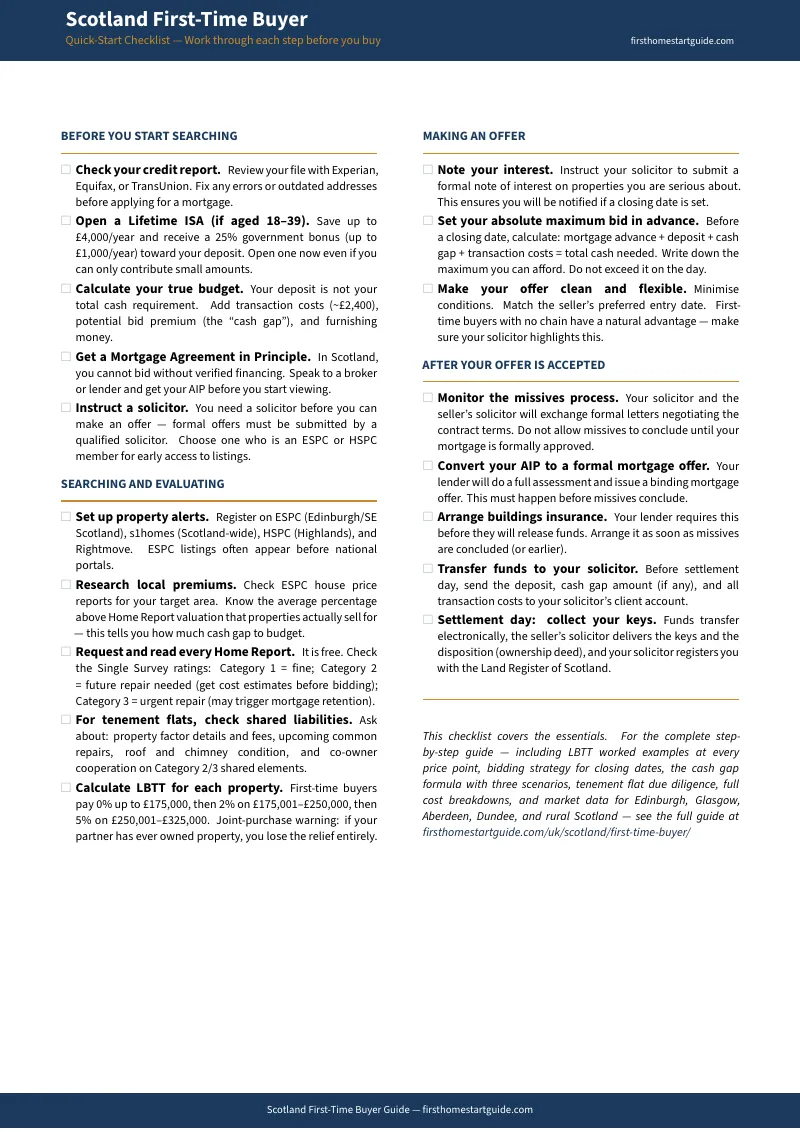
Download the free Quick-Start Checklist to see the step-by-step action plan covering LBTT calculations, blind bidding essentials, Home Report ratings, and the missive timeline. When you're ready for the full decision system — complete with bidding worksheets, tenement risk assessment, LIFT scheme analysis, and the cash-gap calculator — the complete guide is here.
You've saved the deposit. Now stop the sealed bid system from taking more than it should.
Frequently Asked Questions
What if the rules change after I buy?
We update the guide when the rules change. Email us any time, even years later, and we'll send you the current edition free.