
You Ran the Cap Rate Numbers on a Cleveland Duplex. They Look Spectacular. Nobody Told You That the City Will Tax Your Rental Income at 2.5%, the House Needs a Lead Safe Certificate Every Two Years, and Accepting $50 of Future Rent After a Three-Day Notice Can Waive That Notice.
You found a double on the West Side — an over-under two-family with separate meters, listed at a price that would barely buy a parking spot in your home state. You plugged the gross rents and the asking price into your spreadsheet, subtracted 8% for management, estimated insurance and taxes from the county auditor's website, and the projected cap rate came back at 11.2%. You may have also looked at Columbus properties after reading about Intel's $28 billion semiconductor campus, or Dayton rentals near Wright-Patterson Air Force Base where military renters may use BAH to help cover off-base rent.
Then Ohio happened. Your spreadsheet didn't include the 2.5% municipal income tax that Cleveland levies on your net rental profits through the Central Collection Agency. It didn't include the Lead Risk Assessment cost: Cleveland says inspections start at $350 and vary by assessor and assessment, and the City charges no application fee. It didn't include the $500+ annual cost of a Local Agent in Charge that the Residents First ordinance requires because you live outside Cuyahoga County. It didn't include the property management attorney retainer you need because Cleveland Housing Court does not allow your LLC to self-represent in eviction proceedings. It didn't include the three months of lost rent after he accepted a $50 partial payment following the three-day notice: Ohio courts distinguish rent already due, which does not automatically waive the notice, from future rent accepted after notice, which does. Your 11.2% cap rate is now 6.8%, and that's before the tenant whose security deposit you returned four days past the deadline seeks the amount wrongfully withheld plus an equal amount in damages and reasonable attorney fees, if they provided a forwarding address under ORC 5321.16.
Here's what no single free resource explains: Ohio layers a municipal income tax system administered by municipal offices, CCA, or RITA, depending on the city — where rates in the four markets covered here run from 1.8% to 2.5% on net rental profits — against Cleveland and Toledo lead-safety programs for pre-1978 rentals, including Toledo's $25-per-unit certificate fee and a phased compliance schedule that runs through 2029, with a first-degree misdemeanor applying after written notice and a 30-day compliance order, and each day of continued noncompliance a separate offense — against an absentee-owner registration system with criminal misdemeanor penalties and joint civil liability for your appointed local agent — against a judicial mortgage-foreclosure process that traps distressed-note capital for 12 to 18 months — against an eviction procedure where the exact statutory language of a single warning paragraph determines whether your case survives or is dismissed at the first hearing — and Ohio's 2026 HB 186 property-tax changes, which include leasing one-, two-, and three-family homes within the definition of residential activity for a partial exemption. Each of these has bankrupted real Ohio investors because the information existed — scattered across CCA filing instructions, Cleveland Housing Court local rules, CMHA voucher payment standards, county auditor records, BiggerPockets cautionary tales, and ORC sections 1923.04 and 5321.16 — but nobody assembled it into a single operational manual calibrated to how Ohio rental investing actually works.
The Ohio Investment Property Guide is an Ohio Landlord Compliance System — not a motivational overview of Midwest cap rates, but a structured reference that maps every Ohio-specific municipal tax, lead paint mandate, LAIC registration, eviction procedure, DSCR financing mechanic, and market-by-market yield analysis into a process you work through before your earnest money is at risk. It replaces months of cross-referencing CCA tax forms, Cleveland Building and Housing certification requirements, Housing Court local rules, CMHA inspection checklists, and county conveyance fee schedules with a single guide that tells you exactly what to budget, exactly what to file, and exactly where deals go wrong in this state.
What's Inside the Ohio Landlord Compliance System
A comprehensive 65-page guide, a quick-start checklist, and 8 standalone printable tools (10 PDFs) — covering every stage from entity formation through exit strategy, built specifically for the tax structures, compliance mandates, and legal procedures that make Ohio different from every other state:
Municipal Income Tax Filing System
Ohio's municipal income tax is the single most financially destructive blind spot for out-of-state investors. Cleveland, Columbus, and Toledo each levy 2.5% on net rental profits. Cincinnati charges 1.8%. Depending on the municipality, these taxes are administered by the city's own tax office, the Central Collection Agency (CCA), or the Regional Income Tax Agency (RITA). The guide explains the CCA rental filing trigger (gross monthly rent above $125, subject to municipal ordinance) and municipality-specific rental tests under RITA, walks through the exact Schedule E deductions that reduce your taxable base, calculates how the municipal tax compresses your effective cap rate by 40 to 60 basis points, and maps the penalty structure: municipalities may impose a 15% penalty on unpaid tax; CCA's current instructions list up to $25 for a late return, with the first late-filing penalty abated after the return is filed; and the 2026 interest rate is 9%. Ohio law permits prosecution for failure to file within six years. It covers the specific trap where out-of-state investors who also reside in an Ohio municipality may owe taxes to both their residence city and the city where the property is located — and explains the credit system that may or may not offset the overlap.
Four-Market Yield and Appreciation Analysis
Ohio is not one real estate market. Cleveland delivers 8.8% to 8.9% multifamily cap rates and single-family gross yields above 10% — but vacancy runs 8.5% to 9.5% and the West Side and East Side are functionally different economies. Columbus operates on a 2.0-month housing supply with cap rates compressing to 5.75% to 7.0%, anchored by Intel's semiconductor campus: Intel's February 2025 schedule placed Ohio One Mod 1 operations in 2030-2031 and Mod 2 in 2032. Intel's 2025 annual report says Ohio construction slowed and warns that if it pauses or discontinues development of future process technologies, it would likely discontinue the Ohio facilities. Its Q3 2026 filing still lists a new Ohio fab as a long-term investment. Cincinnati offers $1,560 average rent, 3.8% vacancy, and recent Connected Communities changes that allow middle-housing buildings within a quarter mile of its 39 Neighborhood Business Districts and make rowhomes easier to build in the densest single-family zone. Dayton delivers stable cash flow anchored by Wright-Patterson Air Force Base's approximately 30,000 employees, $1,093 average rent, and military renters who may use BAH to help cover rent when government quarters are not provided. The guide includes average rents, cap rate ranges, vacancy rates, rent growth percentages, and the specific economic drivers that determine which strategy works in each market — so you match your investment thesis to the right city instead of deploying capital blindly.
DSCR Loan Underwriting Breakdown
Debt Service Coverage Ratio loans are the dominant financing vehicle for scalable Ohio investment. The guide explains how rates are mathematically calculated from the 2-Year Treasury Yield plus a lender-specific risk premium based on FICO score, loan-to-value ratio, property type, and DSCR ratio. It covers the 1.00 minimum DSCR threshold, the 1.15+ sweet spot for best pricing, and the $150,000 minimum loan amount that many DSCR lenders enforce in depressed Cleveland and Dayton submarkets — which means sub-$100,000 properties often require cash acquisition or portfolio lender financing. It walks through sub-1.00 DSCR programs for transitional assets, the impact of Ohio's judicial foreclosure timeline on hard money risk premiums, and Ohio's residential mortgage prepayment rules: for mortgages on properties with two or fewer residential units, an early prepayment penalty is capped at 1% of original principal before five years and barred after five years; for qualifying first-lien loans under approximately $116,536 in 2026 made or arranged by a mortgage broker, loan officer, or nonbank mortgage lender, no prepayment penalty may be charged.
Cleveland Lead Safe Certification Decision Matrix
Every residential rental in Cleveland built before 1978 must hold a valid Lead Safe Certification or qualify for an exemption. Cleveland says lead inspections start at $350 and vary by assessor and assessment; the City charges no application fee. The alternative is the 20-Year Combined LIRA Exemption: a higher upfront cost ($850+ for XRF analyzer inspection alongside the risk assessment) but eliminates biennial re-testing entirely. The guide runs the break-even analysis between the two paths, explains how the 20-year exemption dramatically increases resale value and can address FHA lead-based paint requirements when a child under six resides or is expected to reside in the home, and covers Toledo's updated TMC 1760 program: a $25-per-unit certificate fee, a five-year certificate after a passing inspection, and phased compliance deadlines through June 30, 2029. After written notice and a 30-day compliance order, each day of continued noncompliance is a separate first-degree misdemeanor offense. It includes the Shaker House LLC appellate precedent where the Ohio Court of Appeals held that Cleveland Housing Court could not use Local Rule 3.015 to deny restitution in an eviction action solely because the owner lacked a Lead Safe Certification — a ruling on the court's equitable powers in forcible-entry-and-detainer cases.
Residents First Ordinance and LAIC Compliance
Cleveland's Residents First legislation requires any rental property owner residing outside Cuyahoga County or its contiguous counties (Medina, Summit, Portage, Geauga, Lake, Lorain) to appoint a Local Agent in Charge — a human being who resides in Cuyahoga County and shares joint legal and financial liability for the property's physical condition. If your tenant creates a code violation and you fail to fix it from out of state, the City of Cleveland holds your LAIC personally responsible — and can assess civil fines directly. Failure to register a LAIC prevents the issuance of a rental occupancy certificate and triggers criminal misdemeanor charges against the property owner. The guide explains the registration process, the indemnification amendments that theoretically protect LAICs but create practical reluctance among property managers, the $500+ annual cost of specialized compliance firms willing to serve as registered agents, and the strategic implications for portfolio structuring and property management contracts.
Section 8 and CMHA Voucher Operations Manual
A dedicated breakdown of Housing Choice Voucher investing through the Cuyahoga Metropolitan Housing Authority. Includes the 2026 CMHA payment standards table (1-bedroom $1,005 through 5-bedroom $1,910), the arbitrage mechanics that make voucher rents systematically exceed market rents in Class C Cleveland neighborhoods, and the Housing Quality Standards inspection requirements that determine whether your unit qualifies. The guide explains the owner/family responsibility distinction: if a PHA determines that the tenant or a guest caused an HQS deficiency and waives the owner's responsibility to remedy it, federal rules prohibit withholding or abating HAP for that deficiency and allow the PHA to enforce the family's obligations. It also covers the circumstances in which HAP can be withheld or abated for owner-responsible deficiencies, the screening standard that separates profitable Section 8 operators from those who lose money (require independent income at 3x the tenant's portion of rent), the utility inclusion strategy that can boost your rent determination by absorbing specific utility costs, and the bureaucratic timeline for scheduling inspections and rent determinations.
Ohio Eviction Procedure: The Complete ORC 1923.04 Walkthrough
The eviction process in Ohio is rapid when executed correctly (four to eight weeks) and catastrophically slow when executed incorrectly (months of resets). The guide reproduces the exact statutory warning paragraph that must appear verbatim and conspicuously on every three-day notice — because omitting or altering a single phrase can lead to dismissal. It covers the day calculation (excludes the day of service, weekends, and state holidays), the statutory service methods (certified mail with return receipt, personal hand delivery, or leaving the notice at the tenant's usual abode or the premises), and the partial-rent rule: accepting future rent after serving the notice waives that notice, while accepting rent already due does not automatically do so. For Cleveland properties, the guide covers the Housing Court's current entity-status procedure: Rule 3(B)(1) lets an entity filing 50 or more eviction complaints a year apply for an order recognizing its Ohio Secretary of State status, while Rule 3(B)(2) lists the required application materials. The court's eviction procedures separately list proof of current ownership among the filing documents. The guide also covers counsel for organizational owners and the separate Corporate Docket procedure for business-entity defendants in criminal Housing Court cases, where a referred case generally remains until an attorney files a Notice of Appearance and Authorization to Enter Plea.
Security Deposit Rules and Double Damages Liability
ORC 5321.16 requires an itemized deduction notice and the amount due within 30 days after the rental agreement ends and the landlord receives possession. The tenant must provide a written forwarding address to be eligible for statutory damages and attorney fees. If the landlord wrongfully withholds money, the tenant may recover the amount due plus damages equal to that amount and reasonable attorney fees. A $1,000 deposit wrongfully withheld can therefore mean $2,000 total, plus reasonable attorney fees when the tenant supplied a forwarding address. The guide also covers the 5% annual interest requirement on the portion of a deposit exceeding $50 or one month's rent, whichever is greater, when the tenant remains in possession for six months or more.
2026 Property Tax Reform Impact Analysis
Two pieces of legislation enacted in 2025-2026 directly alter the tax burden on Ohio rental investors. HB 186 rewrote the residential partial exemption from qualifying levies. Ohio's definition of "residential activity" includes leasing single-, two-, and three-family dwellings. The exemption is 7.5% in the first tax year to which the amendment applies, increases by a cumulative 2.5 percentage points in each of the next two tax years, and is zero after that. HB 335 and its later amendments are reflected in ORC 5705.316, which limits increases for certain levies within the ten-mill limitation during county reappraisals or triennial updates using an inflation factor equal to the greater of 0% or the GDP deflator change over the preceding three years. The guide includes the county-by-county conveyance fee table for Ohio's primary investment markets (Cuyahoga $4 per $1,000, Franklin $3, Hamilton $3, Montgomery $3), the 2026 Ohio tax schedule, and CCA's sale-of-business-property rules: capital gains and losses are excluded from net profit, ordinary gains including Section 1250 depreciation recapture are taxable, partnerships and S-corporations add a 20% adjustment to unrecaptured Section 1250 gain, and C-corporations apply the Section 291 adjustment.
Entity Formation and Portfolio Structuring
Ohio's LLC formation is among the most cost-effective in the nation: $99 one-time filing fee, no annual report requirement, no franchise fee, no publication requirement. The guide covers the Articles of Organization filing, registered agent requirements (must maintain a physical Ohio address), and the multi-entity strategy that allows investors to compartmentalize risk across individual assets or property portfolios. It explicitly addresses the Cleveland Housing Court attorney mandate for organizational owners — an ongoing operational cost that must be budgeted from the first acquisition.
Distressed Asset and Tax Lien Acquisition
Ohio's judicial mortgage-foreclosure process sends mortgage foreclosures through the county Court of Common Pleas, trapping investor capital for 12 to 18 months from complaint to possession. The guide maps the entire timeline: the 28-day answer period after service of summons and complaint, when a plaintiff may seek default if no answer is filed; the appraisal and sheriff's sale advertising requirements; the debtor's right to redeem the property by paying the judgment, costs, and interest any time before court confirmation; and the federal 90-day notice requirement for bona fide tenants, whose bona fide lease may otherwise continue through its remaining term. It covers the Assignment of Rents rider for collecting rent during pending foreclosure litigation, and H.B. 493. The bill's current introduced text would end public-auction tax-certificate sales on January 1, 2027, but it has not become law; ORC 5721.32 still authorizes the sales.
Fix-and-Flip Regulatory Navigation
Ohio splits contractor licensing between state and municipal jurisdictions. The Ohio Construction Industry Licensing Board licenses electrical, plumbing, HVAC, and related trade contractors; applicants generally need five years of trade experience or an accepted alternative, pass an exam, and pay a $25 license issuance fee. General contractor licensing is municipal: Columbus requires a General Contractor license backed by a $25,000 surety bond. Its separate Home Improvement Limited Contractor license covers specified residential work and has separate requirements. The guide covers the physical challenges of Ohio's pre-1930 housing stock (knob-and-tube wiring that DSCR lenders and insurers refuse to underwrite, sandstone foundations damaged by decades of freeze-thaw cycles), and positions lead paint abatement as a strategic value-add — completing full abatement during renovation, followed by a Lead Inspection and Risk Assessment showing no hazards, qualifies the unit for the 20-year Lead Safe exemption, dramatically increases After Repair Value, and satisfies FHA's repair requirement for defective paint surfaces on pre-1978 properties.
Exit Strategy and 1031 Exchange Planning
The guide maps Ohio's favorable exit environment: a 2.75% marginal state income-tax rate on taxable nonbusiness income over $26,050 in 2026, CCA's distinction between excluded capital gains and taxable ordinary gains on property sales, and conveyance fees of $3 to $4 per $1,000. It covers the 1031 exchange strategy that institutional and sophisticated retail investors commonly execute in Ohio — incubating capital in high-yield Cleveland or Dayton assets, then rolling accumulated equity into newer, low-maintenance Class A inventory in the rapidly appreciating Columbus tech corridor. It warns investors that CCA treats Section 1250 depreciation recapture as taxable ordinary gain and provides entity-specific adjustments.
Who This Guide Is For
- Out-of-state investors targeting Cleveland cap rates, Columbus appreciation, or Dayton military housing who need to understand the hidden operating costs before they destroy their spreadsheet projections with municipal taxes, lead certifications, and LAIC compliance fees they didn't budget for
- First-time Ohio landlords who need the exact ORC statutory language for eviction notices, the 30-day security deposit return deadline, and the Cleveland Housing Court rules that apply specifically to LLC-owned properties before their first tenant stops paying
- Section 8 and CMHA investors who want to maximize voucher rent determinations, understand owner and family responsibility for HQS deficiencies, and screen voucher applicants using the income standards that separate profitable operators from those subsidizing tenant negligence
- Fix-and-flip operators who need the lead certification strategy that adds resale value, the municipal licensing requirements that vary by city, and the physical infrastructure challenges specific to pre-1930 Ohio housing stock
- Note and tax lien investors who need to model the judicial foreclosure timeline into their holding cost projections and track the latest HB 493 proposal on delinquent tax-certificate sales
Why Free Tools Won't Save You
The free information exists — scattered across BiggerPockets forum threads where veteran Cleveland landlords warn newcomers about RITA, CCA filing pages buried three levels deep on municipal websites, Cleveland Housing Court local rules published as PDFs that contradict the simplified explanations on real estate blogs, and CMHA policy manuals that no turnkey provider includes in their marketing materials.
The problem is not that the information is hidden. The problem is that it's fragmented across dozens of sources that don't reference each other, written in legal and bureaucratic language that obscures the financial impact, and organized by issuing authority rather than by the investor's actual decision sequence. You need to know your municipal tax obligation before you make an offer — not three years later when the CCA sends a compliance letter. You need the Lead Safe Certification cost in your underwriting model at the acquisition stage — not after closing when Cleveland Building and Housing issues the first $200 fine. You need the exact eviction notice language before your first tenant defaults — not the morning of the hearing when the magistrate dismisses your case because the warning paragraph was paraphrased instead of quoted verbatim.
The Ohio Investment Property Guide compresses the regulatory research, the tax calculations, the compliance checklists, and the legal procedures into a single reference organized around your investment timeline — from entity formation through exit. Every chapter exists because a real investor lost real money by not knowing what was in it.
100% Satisfaction Guarantee
If the guide doesn't give you a clearer picture of Ohio's municipal tax obligations, compliance costs, and legal procedures, email hello@firsthomestartguide.com for a full refund, no time limit. No questions, no friction.
Get the Free Checklist — or Get the Full Guide
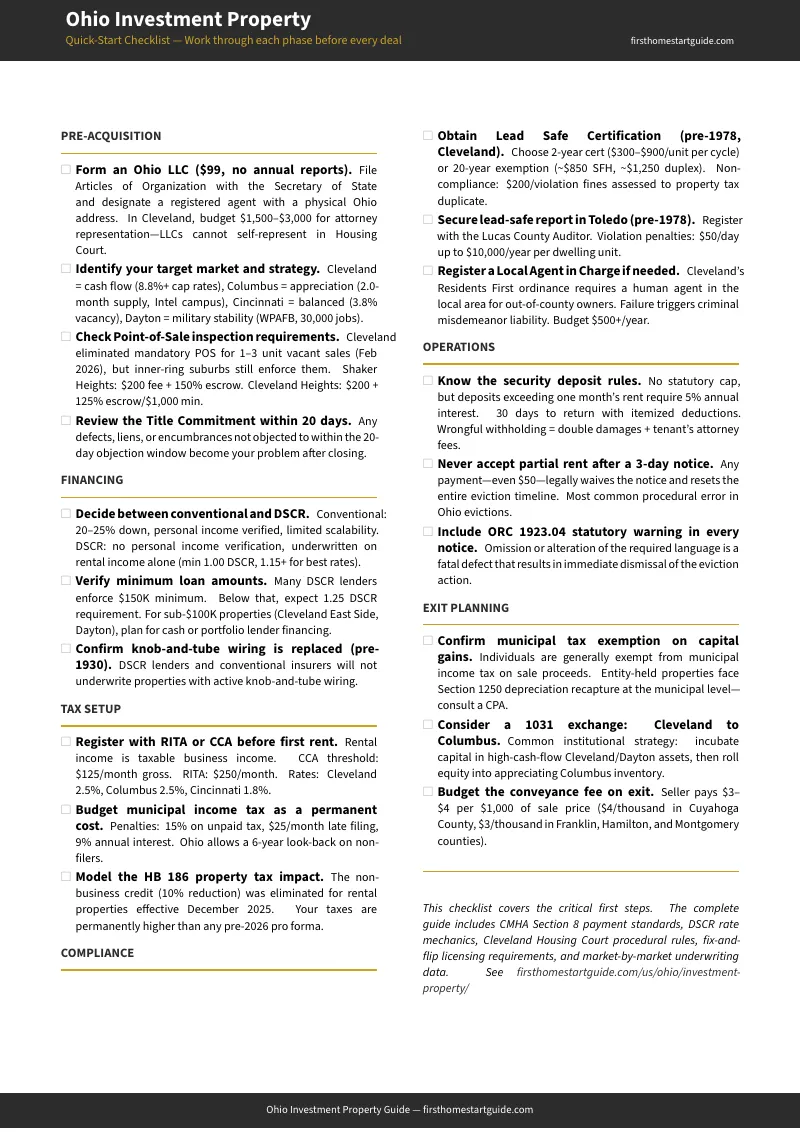
Download the Ohio Investment Property Quick-Start Checklist for free — 19 items covering entity setup, financing decisions, tax registration, compliance requirements, and operations essentials. It tells you what to do.
The full Ohio Investment Property Guide tells you how — with the exact statutory citations, worked financial examples, market-by-market yield data, and compliance procedures that turn the checklist items into executed results. For less than the cost of a single Lead Risk Assessment inspection, you get the operational manual that protects your investment from Ohio's regulatory traps.
Frequently Asked Questions
What if the rules change after I buy?
We update the guide when the rules change. Email us any time, even years later, and we'll send you the current edition free.